





Eye For Film >> Movies >> The World Of Love (2025) Film Review


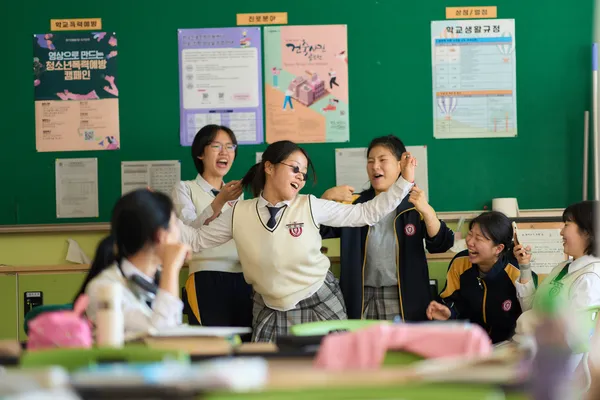

With a title which sounds whimsical and with early scenes of gentle comedy that centre on the social interactions of teenage girls, Yoon Ga-eun’s latest work, a hit in its native Korea, might come across as light-hearted fun. When it first introduces its darker theme, it comes as a shock. This is a story which addresses many aspects of love and sex, including sexual things done without any love at all, but most of all it’s about one girl’s journey to being comfortable with herself.
That girl is Joo-in (Seo Su-bin), whom we find working on softcore erotic pencil sketches in a rowdy classroom, before she goes outside for football practice and gets into a playful scrap with a friend, accidentally knocking down another boy in the process. Her happy-go-lucky world is pulled into focus by a large red apple sitting on a counter. A friend, noticing that she’s distracted by it, offers her one from her father’s orchard, but Joo-in says she hates apples.

We never find out what exactly the apple represents to her, but the fact that such a simple thing grabs her attention in a way she makes an effort to downplay might be a clue to the past of which she has, to date, said nothing to her friends. All the changes when the boy she knocked over, Su-ho (Kim Jeong-sik), approaches her with a petition. A sex offender is due to be released from prison into the local area, and every student has signed in objection, except her. Her objection is not to the idea itself, but to the way it writes off survivors of sexual violence as ruined for life. The revelation that follows – quickly retracted, but a first step towards something bigger – changes the whole tone of the film, and reshapes her life.
Running parallel to Joo-in’s story is a subplot about Su-ho’s efforts to protect his toddler sister, Noo-ri, and find out why she keeps coming home from kindergarten covered in bruises. Between these two intersecting tales, the film addresses a multitude of issues around childhood trauma and its wider effects, across time and across communities. The intelligence and sensitivity with which it does so really makes the film stand out. It’s an important contribution to the movement for change both in Korea, where conservative attitudes still make it difficult for survivors to get the support they need, and indeed in the West, where there is still a long way to go to defeat stigma, dismiss myths and enable healthy discussion.
Underlying much of this is Joo-in’s defiant question: are victims permanently damaged by their experiences, or can they live life on their own terms? There is a plea here for recognising survivors as complex individuals whose lives have a lot more going on than just what might relate to abuse, but Joo-in has to reckon with aspects of her own behaviour, wondering what is really her and what might have been shaped by past experiences. She is told to be less violent in taekwondo class, and enjoys games like hitting the punch bag in the local arcade. She has difficulty dealing with relationships, having conflicting instincts about sex. Still, there are other factors to consider. What kind of affect has living around other people’s prejudices had on her?
Many of those prejudices come pouring out in a conversation between three of her classmates, in one of the few scenes in which she doesn’t appear. They’re not individually challenged, but the surrounding context highlights their absurdity. Alongside this is another scene in which Joo-in brings her boyfriend Chan-won (Kim Ye-chang) to a volunteer group without checking first, upsetting a rape survivor who struggles to feel safe around unfamiliar men. The women in the group are annoyed with the survivor for objecting, putting their social comfort ahead of her well-being. Again, viewers are left to form their own opinions, but Joo-in, initially surprised by her reaction, goes on to become more sympathetic towards her, taking the important step of recognising that different people respond in different ways to similar traumas.
Despite this difficult subject matter, The World Of Love remains a tonally balanced film. We see Noo-ri getting age-appropriate sex education in kindergarten, putting stickers on body parts where nobody should touch her, and a misunderstanding reminds her teachers of her very different , much lighter perspective. We also get to see a magic show ineptly but endearingly performed by Joo-in’s little brother Hae-in, whose greatest complaint in life is being made to pee off the balcony of their flat when she, like so many teenagers, takes an unreasonable amount of time in the bathroom.
The film also deals with Joo-in’s complex relationship with her mother, who clearly loves her but failed to recognise what she needed when it mattered most, and is handling that subsequently by retreating into alcohol. The restructuring of their bond that occurs as a result of Joo-in growing older is complicated by the past. The film makes no hard judgements about responsibility, instead allowing these character dynamics to develop naturally, with room for nuance. It is refreshingly open to possibility throughout, leading up to a final scene which positions all the rest in a wider context and looks to the future in a bold new way.
Reviewed on: 27 Nov 2026


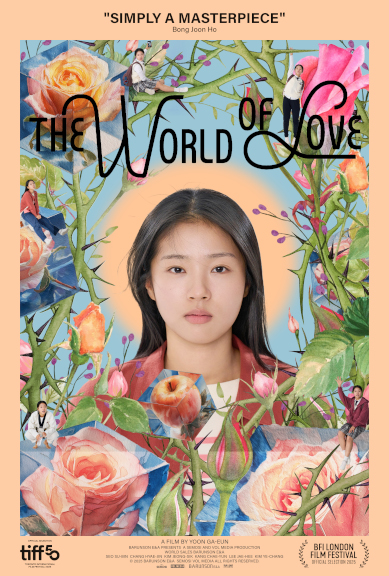
Director: Yoon Ga-eun
Writer: Yoon Ga-eun
Starring: Seo Su-bin, Chang Hyae-jin, Kim Jeong-sik
Year: 2025
Runtime: 119 minutes
Country: South Korea
Search database: